
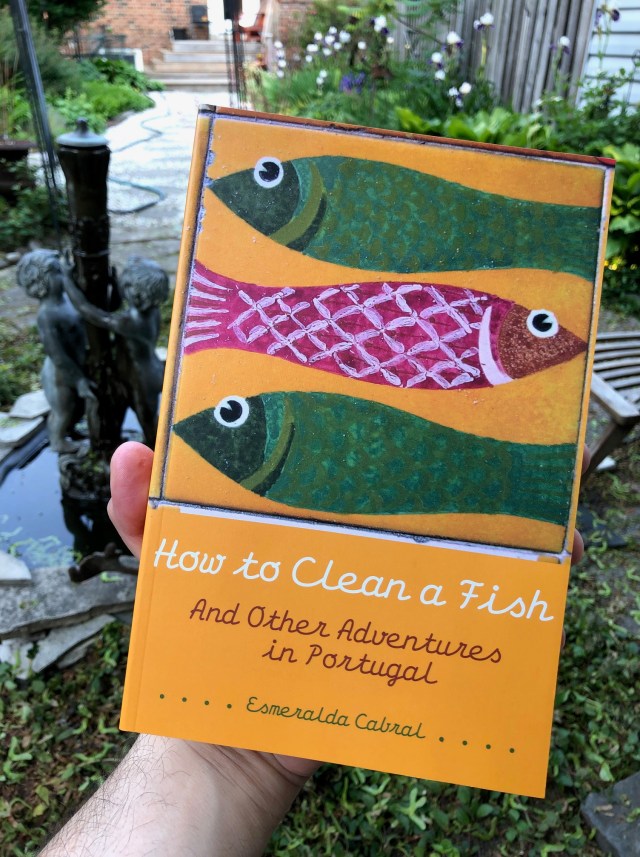
I spent the weekend sitting in my garden, with a most enjoyable read of How to Clean a Fish: And Other Adventures in Portugal by Esmeralda Cabral.
I haven’t been to the Costa da Caparica, near Lisbon, but after reading Esmeralda’s travel memoir of her family’s stay for eight months in Portugal, I felt like I had been there each step of the way, from the cold winter months to the start of summer when the family, including their beloved Portuguese Water Dog, Maggie, return home.
Esmeralda invites her readers to share in the most intimate details of that journey as she tries to make sense of her cultural identity, belonging, and reconnection with a place called home. But the question of what is home is difficult to define, especially when you are torn between two worlds, that of your childhood and where you live now. The writing is crisp and smooth and before you know it, you are drawn into her family’s exploration of a geographical setting away from their home in Vancouver, Canada.
Esmeralda was born in the Azores and came to Canada at the age of seven. Reading her account of childhood I could not help but see so many similarities between our journeys from a mid-Atlantic island to the wide open spaces of Edmonton for her, Toronto, for me.
I could feel her struggle with the self-identity question of “where do I belong,” as each place claims a part of her. The Azores, mainland Portugal, and Canada. It’s a question I have asked myself for most of my life and a question most immigrants ponder on. The sense of home is ultimately where you are with those you love and Esmeralda found that sense of belonging with her husband and children beside her on this journey.
Having to translate from Portuguese to English for her Canadian family was a disruption from simply just being able to dive fully into one language: always aware of the need to translate what others are saying. I could identity with Esmeralda’s desire to be fully immersed in the Portuguese language while she was in Portugal and yet having to temper that desire with the need to communicate to her family what locals were saying.
There are delightful scenes that draw you in to the flavour of the local markets, the people who work and live in Portugal, as Esmeralda, who is not shy to interact with the friendly people she meets, learns how to clean a fish, for example, a skill which gets elevated to the title of her book. Food, in fact, is so interwoven with her storytelling, that I could taste the delicious recipes along the way. These recipes are thankfully included at the end of the book, and I plan to try them this summer.
Esmeralda ends her travel account after returning to Vancouver with this thought: “And that is the essence of my saudade – one of many leavings, but also, always, of returnings.
At times heartbreaking with loss and longing for loved ones, at other times hilarious with mishaps along the way, How to Clean a Fish is a great read.


 Emanuel Melo torontonian azorean writer
Thank you Emanuel. I will read this lovely story later on this summer. It sounds delightful.
LikeLiked by 1 person
Thanks Carol. It is delightful and I’m sure you’ll enjoy reading it.
LikeLike
It sounds fascinating! I love the art on the cover of the book.
LikeLiked by 1 person
Hi Caroline, it doesn’t surprise me that you love the art on the cover. I think it’s visually great, too.
LikeLiked by 1 person
Thanks for your recommendation, Emanuel.
LikeLiked by 1 person
Gotta read that. Sounds good and I’ve spent many summer afternoons in Caparica, Lisbon’s “People’s Beach”.
When you have a chance this summer, read ‘Half Bads in White Regalia’, a great youth memoir by Cody Caetano, a young Portuguese-Indigenous writer.
Powerful stuff !
LikeLiked by 1 person