
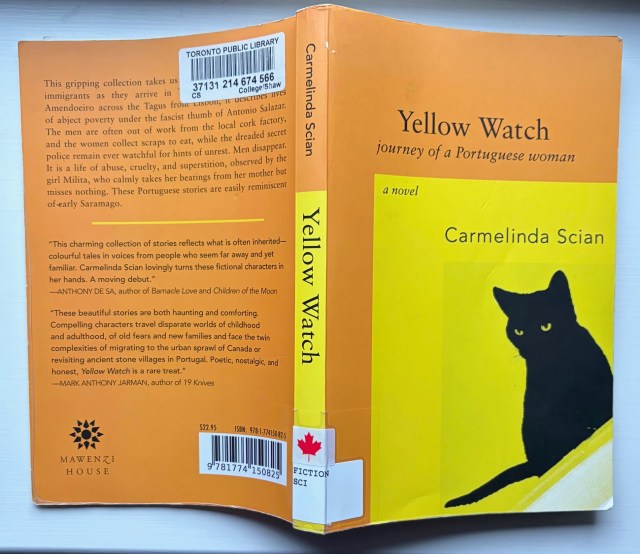
In recent years, I have relied with gratitude on the Toronto Public Library for providing me with books that, regardless of where they are located in the city, are sent to my local branch for convenient pick-up upon my request. It’s a service that recognizes the importance of making books available easily and equitably to interested readers living in Toronto. The public library is the perfect solution to satisfy my need to read something new.
For decades of my life, purchasing books, increasing the size of my own private library, was the joy experienced by the collector in me. But I no longer need to own every book I read. I also don’t have space at home for more. I still buy books, but rarely. For a new book to become part of my personal library, it has to entice me with writing that captivates me enough to want to give it a place of honour in my home.
This is what happened with Carmelinda Scian’s debut novel, Yellow Watch, Journey of a Portuguese Woman. The title may suggest a memoirist journey but it’s a novel written in the form of stories, beautifully interwoven chapters that feel like quilt squares sewn together to reveal the story of Milita Ferreira’s life from a faraway time in the Portugal of the 1960s, starting in Algarve, then later moving to the small village of Amendoeiro, across the Tagus River from Lisbon, and seamlessly continuing forward to the time of immigration to Canada, specifically to the Toronto of the 1970s, and the subsequent decades until the story ends in the late teens of the new century; four decades, as Milita reflects near the end of the novel, “spent at the smithy of life trying to cobble a new me.”
Carmelinda Scian’s details of place and time are rendered masterfully by references to the political and social events that mark the decades all the way from the days of the PIDE, Salazar’s sinister and secret police and their attempts to destroy citizens who went against the state in the smallest ways, to the FLQ crisis in Canada, as the background to lives of poverty, oppression, social conventions, immigrant challenges, and the pursuit of a new life, always linked to the past in an never-ending circular awareness of what has come before and what may lie ahead.
I found an excellent and detailed description of the novel in a Goodreads review by writer Ian Colford and I don’t feel it’s necessary to duplicate here what has already been written so precisely and well by another appreciative reader.
Suffice it for me to add my endorsement of Yellow Watch as a book which will mesmerize through its sparse prose, beautifully crafted without sentimentality and never flinching from raw truth. Carmelinda Scian does not shy away from difficult subjects such as prostitution, abortion, fixed marriages, family violence, and poverty. She handles each with the skill of a surgeon, or an investigative reporter, honest in her revelations but without judgment of the facts, simply allowing us, the reader, to decide how to interpret a person’s life history, in this case, Milita Ferreira. I hope you will get to know her by reading Yellow Watch, Journey of a Portuguese Woman.
The highest praise I can give Carmelinda Scian is that she is a good writer.
Here’s an excellent interview and introduction to Carmelinda Scian in the Malahat Review: The Truth of Human Experience: Alexandra Handley in Conversation with Carmelinda Scian


I read Carmelinda’s book and agree with you. It’s a very good read.
LikeLiked by 1 person