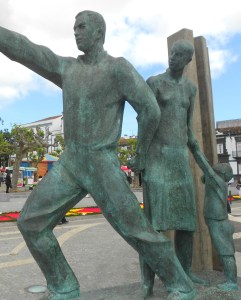
The Emigrantes

The EmigrantesThe Emigrante Boy

I came upon the Monumento ao Emigrante in Ponta Delgada, across Avenida Infante Dom Henrique, close to Forte S. Brás and Campo de São Francisco: a bronze family in a permanent act of immigrating. The father, with one arm lifted high, points towards the future, his other hand holds fast to his wife’s hand as she stands behind him, holding the hand of their little son. Neither parent acknowledges the child’s intense plea to stay.

This homage to Azorean immigrants left me stunned when I first saw it in the year 2000. The statues were a visual symbol of me and my parents and all the thousands of families who left the islands for other worlds. It captured the grief and tearing apart I had felt decades earlier when, one rainy dark morning, I walked down the street with my parents, against my will, to a foreign country.

I had traveled to the Azores with my Anglo-Canadian partner, excited to show him the place of my birth and early childhood. For over six years he had heard my stories of immigration. The statue revealed for him our lives as emigrantes in ways I could not have anticipated. He wept with heartfelt sorrow as he finally understood the meaning of saudade.

It also frightened him to witness my visceral reaction to the island of my birth. The encounter provoked shock waves of emotion through me right from the moment I spotted the presépio landscape from my airplane window. The smells, the sounds, the humidity and the scent of ocean clinging to walls, awoke all my dormant longing and desire for my childhood home after such a long absence.

He saw me raptured into a world of mythical magnitude as my Canadian “self” slipped away. I could not even bear his presence pulling me back to exile. It upset me to speak English as I no longer wanted to be in translation. I wanted to immerse myself in the Portuguese language. This was the key to entering and losing myself again in my boyhood world. The trip almost ended our relationship, so violent were my emotions of reconnecting with home.

We survived the trauma that our vacation triggered in us, and we are still together, partly because the statues allowed my partner to feel a lasting kindness for my fractured, ambivalent soul: half Canadian; half Azorean; and in many ways still the confused little boy who wondered for so long why he had to leave his island home.

I have returned to the Azores several times since then and each new visit feels like a homecoming. There is less saudade and more healing with each visit, and the pain of my immigration is fading away. Now I stand again in front of the “Emigrantes” wishing that the bronze family might move beyond that captured moment of leaving. I wish I could embrace the boy and tell him that it will be alright.

I hope that we, who have experienced the Azorean diaspora, can be freed, too, knowing that we can belong to our islands again, even though home has become elsewhere.

Originally in Mundo Açoriano, July 24, 2014 and in Twas, Fall-Winter 2014.

 Today is the 48th anniversary of my arrival in Toronto on February 4, 1968


Posted in Uncategorized | 1 Comment

Bowie IS

    Bowie mural near Bloor and Bathurst, Toronto

I first saw Bowie in 1976 when he performed at Maple Leafs Gardens on February 26. I was excited about finally going to see the flashy elaborate stage shows of Ziggy Stardust and the recent, then, Diamond Dogs, elaborate set. I had read all about it in great detail in all the fan magazines of the time. In an internetless age, music writers wrote lengthy articles describing concerts in detail and I expected to see, in person, all the glamour and sophisticated daring of a musician I had come to identify with as a symbol of those who dared to be different.

Instead of the glam rock idol coming on stage, after we listened to Kraftwerk’s eerily beautiful Radioactivity album and watched the surreal short Bunuel film, Un Chien Andalou, Bowie appeared on a black stage, with a single spotlight on his Thin White Duke persona, dressed in tuxedo pants, a white shirt, and a black vest. The sombre heavy riffs of Station to Station filled the stadium, as the song built and built into further frenzy and a new Bowie, stripped down to essentials, commanded my soul. The disappointment of not witnessing a grand stage set and glamorous costumes and funky hairdos was quickly forgotten as his new music took me to new places. The power of his voice, theatrical and commanding, sung new words and, as with every new album, expanded the music landscape.

I was just 17. I had bought extra tickets for the show and invited my older cousins to come with me. Angelo and Berta were old enough but Rita was still a minor and the only way my aunt would allow her to come with us was if my father chaperoned us. And so, after much begging and pleading, the family agreed that 15 year old Rita could come.

It’s the only rock concert my father ever went to. He sat quietly, emotionless, bearing the loud music, the haze of heavily scented pot around us, but he came, nonetheless. He was cool because of this and my cousins respected him for his daring. I am sure my mother, my grandparents, my aunts and uncles were petrified. Everything they heard about these concerts was probably true, but rather than deny my young cousin from coming along, they took a chance. That’s how much they trusted and respected my father.

I have always remembered this connection between my father and me and Bowie. It showed real love for him to get out of his Portuguese Fado concerts at the local parish hall and come see Bowie. I am sure he didn’t like it, but he never said so.

Over those early years of youth, my parents would shake their heads in bewilderment when they’d walk by the living room and watch me go crazy watching Bowie on TV, but they never complained. What they did not understand was that by drawing attention to Bowie on our TV screen, I was really trying to say to them, look, this is me, this is who I am.

Bowie was the most influential musician/pop/rock star of my young life. I discovered him probably by the time I was 15, at first attracted to the hype around his sexuality and androgyny, finding a symbol in him for who I was, this painted man who dared to be so different in 1973. But it was his music, ultimately, that fed my young soul, saw me through adolescence, the teenaged years, young adulthood, and even up to my life today, only 12 years younger than Bowie’s. I still go to his music from time to time: for emotional support, for hope, for commiseration, for a friend. In Rock and Roll Suicide, he sang, Oh, no love, you’re not alone, no matter what or who you’ve been, I’ll help you with the pain…give me your hand, because you’re wonderful, wonderful. He sang hope and courage to my mixed up youth and continued to do so until today and, I suspect, until my end, too.

Today, I was the first to enter HMV to get his latest and last album. It reminded me of those days of long ago when I would line up to buy concert tickets or get the latest Bowie release. Today I am 17 again.

David Bowie, January 8, 1947 – January 10, 2016


Posted in Uncategorized | 5 Comments