

Today I felt like revisiting a short piece of writing I did in 2004 and published by my friend Lise Watson, founder and editor of the magazine ‘Twas (Toronto World Arts Scene), in Volume 8, issue One January/February 2004. I am grateful to her for encouraging me to write this reflection. As I read it again, I am caught up in the memory of that time, 21 years ago, and I resist the temptation to edit and revise this raw, but written from the heart, text. So, here it is:
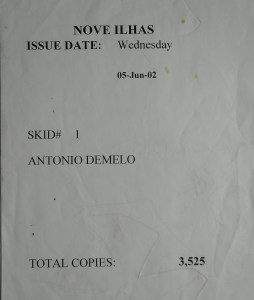
My father, who is retired from full-time employment, has the fun job of delivering one of several weekly Portuguese newspapers to many of the Portuguese businesses in Toronto. Unfortunately, he was not able to work for a period of six weeks this past summer after a major operation. So, my brother and I, in the interest of helping our dad keep his job, volunteered to do the weekly delivery of the “Nove Ilhas,” a name alluding to the Nine Islands which make up the Azores archipelago. We both took a day off work from our administrative jobs at the University of Toronto each week to enter the fascinating world of newspaper delivery guys!
Our mentor and guide for our first time out on the route was our mother, who normally helps my father with the delivery each week. She organizes the contact list, the number of newspapers for each drop off and, generally, tells my father where to go. Now, she’s the one sitting in the back seat, teaching her sons the tricks of the trade. But she’s more concerned about how my brother and I will behave. “No goofing off….don’t embarrass me…All these people know your father….remember that you are representing him.” My brother, who is 28 and married with children, looks at me in disbelief. This is the thanks we get for trying to help? Where is the gratitude? Mom proves to be a tyrant boss: she criticizes us when we ask to stop for a break. “Your father is twice your age and never needs a break. You are malandros, lazy.” Later, we ask “Can we stop for a lunch break?” Again, we get a cold response to this request. Apparently, my parents never take a break and work straight through the 6 to 7 hours it takes them to cover the entire route. Luckily, today happens to be my 45th birthday, so mom takes pity and treats us to lunch at the wonderful Bairrada Churrasqueira on College near Dufferin. We deliver the newspaper there anyway, so it becomes a good strategic stop. The back patio is buzzing with a heavy lunch crowd, mostly speaking Portuguese and enjoying authentic regional dishes. The patio has a stunning large brick oven with a roasting pig on the spit. The place smells of Portugal.
The route is long and there are many stops close to each other. My brother and I are constantly taking our seatbelts off and putting them back on. It’s a natural reflex. However, our mother, the reigning monarch in the back seat overseeing her minions, laughs at us. “I don’t understand you boys… your father never leaves his seatbelt on when on delivery… not when he has to get out of the car every few minutes… this is a waste of time…” My brother and I shake our heads incredulously. “What if we get a ticket?” we innocently ask. “You won’t get a ticket” she assures us, “you’re on delivery!” We make a mental note not to invite her back the following week. She will have to wait at home to hear our weekly report on how it went.
I found the sheer volume of Portuguese owned businesses extraordinary, everything from banks, doctors, bakeries, cafés, butchers, grocery stores, pharmacies, travel agencies, and, of course, ubiquitously, restaurants. Most are located in the official “Little Portugal,” bordered by College, south to Dundas, and by Bathurst west to Lansdowne. However, many businesses are still found in the original Portuguese settlement at Kensington Market, known forever as “Agusta” by the Portuguese, who like other immigrant groups found a welcoming space in this area. You will also find Portuguese restaurants and bakeries spread out throughout other pockets of the city, some as far north as Eglinton and Keele. All these establishments have a special place or box where the newspapers are left and picked up very quickly by news-hungry patrons. One of them is an old man who would be waiting for us religiously at the same time and place every week. Before I could get out of the car, there he would be with hands outstretched asking for two copies of the newspaper. He must be too busy in his old age to wait for me to exit the car and drop my stack of paper at the café in front of him.
I took delight in hearing people speak Portuguese in their everyday environment. With each delivery I would hear a different sound of Portuguese; perhaps the heavy and mumbled closed vowels of the Azorean accent at the local bar/café; or the easier to understand (because more articulated) continental Portuguese at one of the bakeries or grocery stores; or, of course, the melodic Brazilian accent at the billiard hall further down the street. Believe it or not, it is not unusual to find men already hanging out at local bars before lunch, to watch all the latest soccer games via satellite and to have the mandatory pick me up beer. I go inside each place to leave my bundle of papers. At each stop I am usually greeted with a polite “Bom Dia.” I like this act of civility, a last rite from the old country. In some places, the owner or store clerk will ask me how my father is doing. They always send him their cumprimentos (best wishes), and remark that we are such terrific sons for filling in for him like this. The family, after all, is sacrosanct to the Portuguese. All these people who frequent the bars and cafés, the bakeries and grocery stores, eagerly await the weekly papers as the source of news for the abundant upcoming social events, held at numerous social clubs and local parish churches. So, they are happy to see me and my stack of newspapers arrive on time.
I also enjoyed the sound of music! If you want to get a sense of what the Portuguese listen to, pop your head into a bar/bakery, bookstore, or just walk along Dundas and Ossignton area. You will catch a note of fado as sung by Amália Rodrigues, known as the “Queen of Fado” and revered all over Portugal as a national icon; but, more likely, you will hear the fresh young voice and interpreter of fado, Mariza. Her youth, beauty, and hip videos have attracted a new generation of listeners. It might prove even more difficult to hear the sad and haunting music of Madredeus, the most internationally known Portuguese group of the late ‘90s. Their sound, with the luminous yet melancholic voice of Teresa Salgueiro, to the accompaniment of traditional Portuguese guitar, the cello and the accordion is a mixture of fado roots and other traditional styles. Sadder sounding than the fado, the music does not please the sensibilities of many of the older Portuguese immigrants who, like my mother, prefer to hear ‘musica alegre,’ popularly known as Pimba. Pimba is happy and bubbly sounding and borrows from traditional folklore musical styles but adds modern guitars and drum beats. You can hear this sound everywhere but it does not represent the more interesting side of Portuguese music. Compare it to listening to Britney Spears versus Annie Lennox! Finally, at Cabo Verde restaurant south of Dundas on Ossington you will hear the sound of Cesaria Evora and also other less known African/Portuguese roots music.
Needless to say, I have not focused on the tedious details of life as a newspaper delivery guy, of what it’s like to go early morning to pick up thousands of newspapers from the printers, load them in the car, organize the paper route, get in and out of the car every few minutes, organize the paper route, get your hands covered in black ink, dodge the heavy traffic of the day, avoid getting ticketed, and so on. But what I wanted to leave you with is the memory of my weekly journey into the heart of Portuguese community life, a fitting participation on my part, during the year in which we celebrate the 50th anniversary of the official arrival of the Portuguese to Canada. Thanks, dad, for this memorable opportunity! And, oh, yeah, mom, too.



Damn! That actually sounds like fun. How can I get a delivery route?
LikeLiked by 1 person
Lovely Em – thanks for sharing again – please write and post more
LikeLiked by 1 person
Olá Emanuel,
adorei ler este teu texto cheio de vitalidade, informação e humor! Agradeço muito a partilha.
Um grande abraço, Ilda
LikeLiked by 1 person
Emanuel — thanks for the ‘redelivery’! Great piece of writing!
LikeLiked by 1 person
what a wonderful story! I didn’t know about Pimba so I will have to listen to some 🙂
LikeLiked by 2 people