Dundas West Fest: Memória of a changing neighbourhood

Post 11 Atkins and Brock

Post 11 Atkins and B rock Avenue

This June marks the third anniversary of the participation by Memória Luso Vox Portuguese Canadian writers (Humberto da Silva, Aida Jordão, Irene Marques, Antonio Marques, Edith Baguinho, Emanuel Melo) in Dundas West Fest.

In the first year, we read on the street near the intersection of Dundas and Sheridan. Last year we read on the sidewalk in front of St. Helen’s Church as parishioners, mostly elderly, made their way to Mass, oblivious to our presence. Festival goers strolling up and down the street looked our way and kept on walking, but some stopped for a few moments to hear us read our stories and poems, shouted into microphones; yet the words were still carried off by the wind, drowned by several competing musical booths, until they vanished and blended with the sounds of the festival. But we were happy to be part of the cacophony of life on the street.

Perhaps some time later, a casual yet curious passerby, might remember having heard our words: the name Anita; or something about guns and a bird; or that eternity cuts and that words are dripping out of me and I need a bucket; and that a grandmother spent Easter alone. Perhaps then that person will seek out and look for MEMÓRIA: An Anthology of Portuguese Canadian Writers.

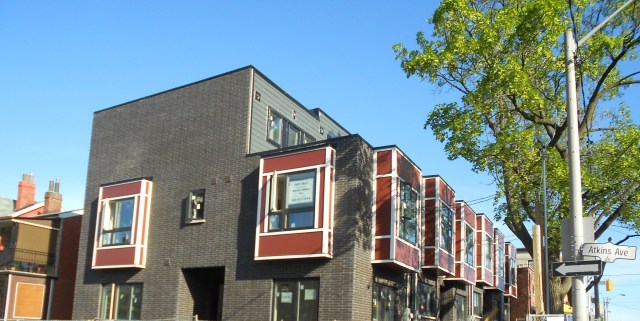
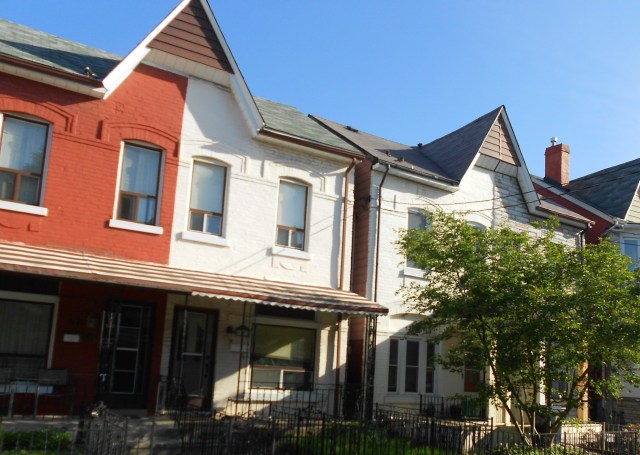
After the performance, I stayed behind to revisit the neighbourhood I had lived in decades ago. A time when mostly Portuguese immigrants occupied old Victorian row houses painted red or yellow. Now, there are condos going up, and a new cluster of townhouses has already appeared at the corner of Brock and Atkins, replacing an old evangelical church. There are fewer Portuguese businesses in the area. Some remain, crammed between new restaurants, coffee shops, bars, clothing stores. The sign for the Portuguese Barber shop is starting to fade, but at least it’s still there. With all these hipster guys moving in, needing haircuts and beard trims, maybe, just maybe, it will survive.

I saw gentrification asserting itself insidiously with the intent of staying. I observed young men with their tattoos and turn-of-the-century beards coming to and from apartments and houses long left by Portuguese families, who moved to Mississauga and Woodbridge and other suburban neigbhourhoods. It’s the old pattern of migration that is in the blood of all Azoreans, always looking away from their islands, whatever the definition of island may be, towards better and far off places.  Not all have moved away. Some are still comfortable staying in the “Dundash” area – their numbers in decline as they age and then…

What I found surprising was the effortless ease with which the remaining Portuguese were living side by side with the new immigrant group in their midst: the Anglo hipsters and the Vietnamese. I wonder what they think of each other and how they get along. Perhaps the newcomers are smug and proud of their ability to co-exist, to even learn to say, Bom Dia, to their elderly neighbour. Isn’t that the coolest thing?

There was a fundraiser in the lawn in front of the parish house; a maze of spread-out tables displayed the usual garage sale items. A young man whose facial hair would have won him a part in an Edwardian period movie, despite his green checkered shirt, shorts and tattooed leg, rummaged through bins full of kitsch, plaster figurines and colourful wall clocks in the shape of cats.  He smiled and waited patiently for his girlfriend to decide whether the glass grape cluster bottle full of some ancient liqueur was worth getting for their new apartment. In front of the church hall, a Portuguese brass band played, parish women sold homemade malassadas “yummy” at $1.50 each, (as written on the sign draped over the table), bifanas at $5 a sandwich, doce or picante, delicious! I ate two bifanas, the sweet juicy meat with sautéed onions on a bun dripping over my hands, sticky and satisfying.

Now I had enough of nostalgia for one day, and crossed town on the subway, feeling the long distance growing between the world I had just visited and the world I live in now. When I got home, I sat in my garden and ate the last of the malassadas, my fingers sticky from the sprinkled sugar that still reminds me of those days when my parents would come home with bags of these sweet treats, happy with their abundance and their life on Dundas.

Luso Vox Memória reading series launch at Dundas West Fest, June 7, 2014 and June 6, 2015 

Dundas West Fest June 11, 2016

Luso Vox writers Aida Jordão, Humberto da Silva and Emanuel Melo will be reading paulo da costa’s poem “ser português/to be portuguese” at 6 PM in front of the Toronto Housing Building at 1525 Dundas, just west of Dufferin.

Posted in Uncategorized | 1 Comment

Embrace the Island for Me

The Azorean poet, Gabriela Silva, had come from the island of São Miguel to speak to the students of the Portuguese Culture Course at the University of Toronto. I was anxious to see her, a writer I did not know, but who I hoped would bring the humid sweet air of the green and wondrous island of my childhood; hidden as it is in the immensity of the Atlantic.

I assumed I would hear Silva speak in the local dialect of my place of birth. However, the poet spoke in English so that everyone could understand. I became sad, to hear her in translation; disappointed that no word of my maternal tongue fell from her lips. Still, I thanked her, whispering in her ear, “When you return, give the island an embrace for me.”

It was autumn in Toronto. The sky was clear like a blue marble. I was sitting in the silence of my garden, looking at the luminous yellow and red leaves on the trees, caressed by the wind, dancing and falling to the ground, with a gentle swirl. The cold wind penetrated my skin, from tip to toe. I breathed deeply, taking in the frigid air like a chocolate ice-cream bar on a hot summer’s day.

I remembered the words of Gabriela Silva when she spoke about the weather in the Azores: its primordial mists, rain and humidity which leaves people with a heavy spirit that is the nature of these islands.

I had forgotten about the weight of rain and of fog. When I arrived in Toronto on a cold February day, I encountered snow: the Canadian winter stole my memory of the heaviness, darkness and fog of the island I had just left behind.

I have lived more than four decades in Toronto, yet there always remains inside of me a vague remembering of the ocean waves that both suffocates and liberates.

Gabriela Silva wrote that, “Wherever there lives an Azorean, whether he speaks bad English or poor Portuguese, he will always be a different being, distinct from others. He feels with the soul, has ocean in his guts, fog in his dreams, and longing in his gaze.” *

In these words I encounter my Self. When I walk the shores of Lake Ontario, with its gentle lapping waves, I hear an echo of the Azorean Atlantic Ocean. It’s an inexplicable connection that reminds me that no matter how much time I have been away from the island, those fogs, that rain and mist, continue to call me from the shore where I stand.

I wrote this reflection at the end of a cruel winter, with snow still covering my garden, despite the calendar indicating that spring had arrived, and I wondered, “What’s the weather like, right now, in my far away island?” And on a whim, I googled the airline that could take me back, SATA International, and booked myself a flight. I’m going to Ponta Delgada, and the anticipation of that encounter already gladdens my soul. I will go back and, myself, embrace the Island!


* Quote from Dizer Adeus, in “Abraço de Mar.” My translation.

Embrace the Island for Me is my translation of the Portuguese text I wrote for Mundo Açoriano, Dá um abraço à ilha por mim, published in 2014.


Posted in Uncategorized | Leave a comment

Dá um abraço à ilha por mim

Chegando à ilha de São Miguel                                                             Photo by Fernanda Sousa


A poeta Gabriela Silva tinha vindo da ilha de São Miguel, para falar aos alunos de português na Universidade de Toronto, e corri ao seu encontro, cheio de saudade para ver e ouvir uma escritora que não conhecia, mas que pensei me viesse trazer um pouco do cheiro marinho e húmido da ilha verde e deslumbrante da minha infância, escondida na imensidade do mar dos Açores.

Pensei que fosse ouvi-la falar, com o sotaque da minha terra natal. Todavia, a poeta falou em inglês para que todos pudessem compreendê-la. Fiquei triste por a ouvir em tradução, esperando que saísse da sua boca alguma palavra na língua materna. Depois da sua palestra, aproximei-me da poeta para lhe agradecer a sua presença, e, murmurei no seu ouvido, “Quando voltares, dá um abraço à ilha por mim”.

Seria outono em Toronto. O céu estava límpido e azulado como um berlinde. Sentava-me no silêncio do meu jardim e olhava as folhas luminosamente amarelas e vermelhas das árvores, que, acariciadas pelo vento, dançavam e caíam ao chão numa languidez suave e final. O vento, gélido, penetrava-me a pele, das pontas dos dedos das mãos e depois, descendo até aos dedos dos pés. Respirei fundo, chupando o ar frio como um sorvete de chocolate num dia quente de verão, caindo no meu estômago com um frio arrepiante.

Lembrei-me das palavras de Gabriela Silva sobre o tempo nas ilhas açorianas, das suas brumas, chuvas e humidade que deixam as pessoas com o espírito pesado da natureza primordial que são as ilhas dos Açores.

Nunca mais me tinha lembrado desse peso da chuva e dos nevoeiros. É possível que tivesse sentido esse peso dentro de mim quando era criança, mas a verdade é que, quando cheguei a Toronto, com os meus nove anos, num dia geladíssimo de Fevereiro, encontrei-me com a neve branca dos invernos canadianos que me roubaram a memória daquele peso e daquela escuridão entre brumas da ilha que deixei.

No entanto, apesar de viver há mais de quatro décadas em Toronto, sempre permanece dentro de mim uma lembrança vaga do mar que afoga a alma e ao mesmo tempo a liberta.

Gabriela Silva escreveu que “Onde estiver um açoriano, quer fale inglês escorreito quer fale português espúrio, estará um ser diferente, distinto dos outros. Que sente com a alma, que tem mar nas vísceras, nevoeiro nos sonhos e lonjura no olhar.” (Dizer Adeus, página 72, in Abraço de Mar)

Nestas palavras me encontro, me identifico, e apesar de estar longe da ilha onde nasci, quando vou à beira do lago Ontário, com as suas ondas suaves, ouço um eco das ondas bravas do mar dos Açores. É uma ligação inexplicável que me ajuda a lembrar que por mais longe que eu esteja das ilhas, aquelas brumas e chuvas e nevoeiros continuam a chamar o mais íntimo do meu ser da margem onde estou.

Escrevo esta reflexão no fim de um inverno rigorosíssimo, com neve ainda cobrindo o meu jardim, apesar do calendário indicar que já chegou a primavera, e pergunto-me, “Como será o tempo agora na minha ilha longínqua, mas sempre dentro de mim.” Um impulso leva-me à Internet e marco um voo com a SATA International. Vou a Ponta Delgada, e a emoção deste encontro já alegra a minha alma. Desta vez, não precisarei de portador, serei eu mesmo que darei o meu abraço à ilha.

Originally published in Mundo Açoriano, 2014

 English translation coming soon.

Posted in Uncategorized | Leave a comment

My father’s 25 de Abril


      Antonio Cabral de Melo

We remember 25 de Abril as a nation’s embryonic struggle towards freedom. But for me, the Portuguese day of liberation took on new meaning when my father was buried on April 25, 2005. For these last nine years, the dual commemorative celebrations, one cultural, the other personal, intertwine and cannot be ever separated in my mind.

My mother tells me a story of how my father wrote to Salazar when he was a young man, newly married and full of debt. There was no one to turn to for assistance, and my father, I don’t know with what tenacity, sent a letter addressed to the Portuguese leader, to complain about the economic woes he faced and to ask for any form of financial help. I suppose he believed in Salazar as a caring father figure, and did not hesitate to send his plea, the way an innocent child will turn to his father for assurance.

My father must have not been afraid of repercussions. Perhaps he wasn’t aware of PIDE, that secret police service of o Estado Novo. But my mother assures me everyone was aware of them and of people spying on each other, so my father must have known, too. Still, so dire was his economic trouble that he sent his plea, with trust, to the highest authority of his Pátria.

Implausible as it is, my father did receive a letter from an official, informing him that the government did not interfere in the private lives of citizens, and were not in the business of giving out handouts.

I am relieved that my father was not put under surveillance for his indiscretion. Perhaps if he had written from Lisbon or some other place in O Continente, the secret police might have taken the time to seek him out to be interrogated for communistic inclinations or for instigating crimes against the regime. But my father wrote from so far away. This Azorean island of São Miguel might have been from another word; a place so remote that electricity did not arrive in my father’s village until the mid-nineteen seventies. So they did not bother to pursue him, either out of laziness or embarrassment of not knowing how to get to the island.

My father, my mother adds, also wrote to a couple of famous Portuguese movie actors, asking them, too, for financial assistance. What led a young man, in his late twenties, with only a rural Azorean quarta classe, to think of writing to such people?

I see in my father’s picture, which I include with this story, someone who dreamed bigger than his insular upbringing. He had left his village at the age of fourteen to work in a variety of mercearias in Ponta Delgada, and eventually opened up his own store for a while. But he was not a good businessman, he gave out too much credit to people who could not have paid him anyway, and soon his debt load increased to such a level that only, he believed, Salazar, could have helped.

The letter he received must have discouraged him, and he could not wait for a revolution to come. Instead, he immigrated to Canada in the early sixties to find work and to better his life.

I am sure that in 1974 we heard about the Revolução dos Cravos but by then life was good for my father and I am sure he gave no thought to it, just as he would have given no thought to Salazar’s passing a few years earlier. Both events were part of a world far away, just as the Azores had been far away to some bureaucrat who had put my father in his place with a stern letter.

The archivist in me would be delighted to have the letter in my hands; the one my father wrote, that is. As for the reply, I asked my mother about it but she assures me that my father just destroyed the letter. “Que disparate,” she says and then adds, “Como é que o teu pai foi pensar que o governo o ia ajudar?” (What nonsense. How did your father ever think that the government was going to help us?)


Originally in TWASMagazine Spring/Summer 2014

Posted in Uncategorized | 3 Comments

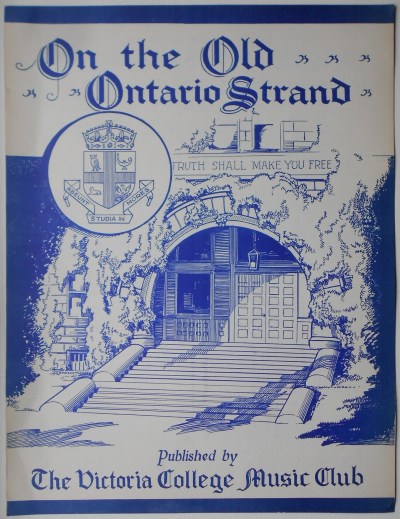
On the Old Ontario Strand

        Sheet music published by J.H. Peel Music Publishing Co., Toronto. Cover   by Virginia Boake ‘48 and Music arrangement by Joyce Belyea ‘46
As much as my writing reveals a nostalgic longing for the place and time of my childhood, I must acknowledge the importance of the last 25 years working as Associate Registrar at  Victoria College.

The best years of my life have been spent on another island, the Victoria Campus within the University of Toronto. This place has been a home, a shelter, a family, a gift, where I have been able to be myself, supported, accepted – even loved.

After graduating from university, I started full-time work at the Office of Admissions in the University of Toronto. Several years later, I walked over from Admissions on Bloor Street to Victoria College on the outer edge of the north east campus. The journey along those few Toronto city blocks felt like going to the ends of the earth. Waiting to greet me was then President, Dr. Eva Kushner, who made a point of offering me a gracious welcome as I started the newly created position of Assistant Registrar.

Her humble welcome was a template for all the people I would come to meet and work with over two and a half decades: professors, administrators, custodians, librarians – to name a few. In fact, all the Vic family, regardless of rank or position, treat each other as equals in our common mission: to be of service to students in our various capacities.

I found refuge in the “Old Ontario Strand, where Victoria evermore shall stand.” Every year, I join the Men’s Traditional Ceremony during Orientation Week. These beautiful September nights are full of promise as we welcome our first year students. We always end the ceremony by singing this traditional song with deep rich voices; years ago echoing in the cathedral-like Burwash Hall and, in more recent years, in the cocoon-like Chapel in Old Vic.

Today, the voices are still strong, and as we sing together, the little boy still inside of me, used to solitary gazing out into the world, finds warmth and a belonging in this company of young lives that makes me grateful for having found my place in this beloved institution.

Over the years I have had the honour of being in the same room with famous people: intellectuals, academics, even film directors. But the only one I remember distinctly is Northrop Frye, quietly standing, lost in the weight of his regal academic robes, waiting for the academic procession to start the year before he died.

In the yearly cycle of convocations and awards ceremonies I have listened to much wisdom and wit but all this pales when I consider the students I have met throughout the years. I have had the honour of listening to them, their dreams and hopes, their confusions, their fears, sometimes despair, sometimes joy, and I have tried to do one thing above all else: listen and acknowledge their life stories as authentically as I can.

As I receive a 25 Year Pin of Service, I am accepting and acknowledging a tangible sign of the best time of my life. Despite the ups and downs that inevitably mark a quarter of a century, Vic has been a constant source of stability and, above all, a home. Even though my time at Victoria is surely closer to the end than to the beginning, the physical space and the spirit of what is Victoria College will forever be a part of my inner landscape.

The little boy who came to Canada from the Azores found a new and welcoming home in Toronto, a city that has nurtured me and embraced me as one of its own native sons, as has Victoria College. I know that when the time finally come to leave Vic, I will most certainly look back on my time there with the same loving gaze which I normally reserve for looking out across Lake Ontario towards the Atlantic Ocean, hoping to still see that place I used to call home.

Posted in Uncategorized | 2 Comments

Reading with my Grandfather on Sunday afternoons


When I was a little boy, around the age of six or seven, I would spend quiet Sunday afternoons lying in bed with my grandfather, reading.

I can still see the Louis XV style bedroom set in our house in Ponta Delgada, the dark ornate wood against the stark white walls, and me under crisp ironed white sheets, resting on cozy pillows, all embroidered with lace made by my grandmother.

My grandfather sat up in bed, under the sheets, too. We did not talk nor acknowledge one another. Instead, we read quietly to ourselves. I browsed through my comics and story books. My grandfather read the newspaper and the Imitation of Christ.

My maternal grandfather was a blacksmith by profession and his fingers were permanently blackened. I remember once, my mother asking me to show him my caderno, my school assignment book, and I panicked at the thought that he would leave a stain on the pages. Memory tells me that I guarded the book zealously against his touch, despite my mother’s anger. To this day, I have the habit of wanting my book pages to remain pristine and new.

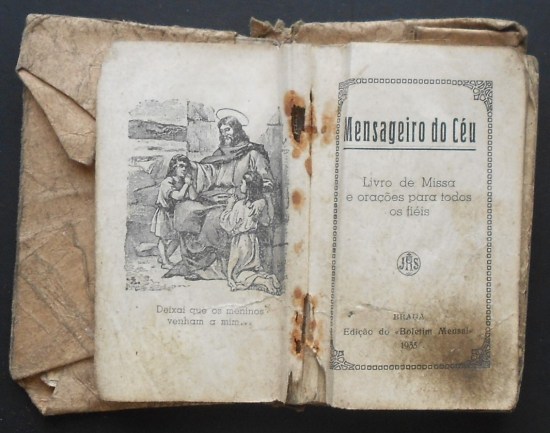
I have a few of my grandfather’s prayer books. They are worn and brittle with age and were used by him until his death. The pages are smudged on the bottom right hand side with deep black thumb prints, a testament to his assiduous reading and prayer.

One day, in the 1940s, during the visit of Our Lady of Fatima to the island, he experienced a miracle as the statue was carried by our house and he prayed for healing. My grandfather had been suffering from a deep wound in his chest that refused to heal, despite constant treatment.

The next day, he went for his daily cleansing of the wound at the doctor’s office. But the doctor was surprised when he saw clear fluid where just the day before pus had filled the wound. “Mestre Duarte,” he said, “How is this possible?” and upon my grandfather telling him how he prayed while the statue of the Virgin passed by his house, his good Jewish doctor replied, “Go and thank your Lady of Fatima. She has cured you.”

My grandfather’s case was documented as an authentic miracle, made the more credible because it was pronounced by a doctor of another faith.

I did not know this story about my grandfather during those quiet Sunday afternoons when we sat in bed, side by side with our books. I only found out years later, as an adult, well after his death, one afternoon in Toronto, so far away from that house and that bedroom of childhood.

Those Sunday afternoons are the memories that sustained me at a time when my father had already left for Canada and I needed the presence of someone strong and silent who made me feel safe.

Today, I treasure the black stains that mark his prayer books, a lasting reminder of the man who used them. If I could go back in time to those Sunday afternoons, I would let him touch my school book and hope that his finger imprint of black would stay on the pages.

Posted in Uncategorized | 4 Comments

Tiago


Post 6 Tiago

At sixty, Tiago (or Mr. James da Silva, his name on the official Staff Directory) had left his job at Crescent School, where he’d taught boys to interpret the beauty of the world through paint on canvas. When a sudden loss of mental equilibrium shattered his mind, leaving him unfit to continue his teaching duties, Tiago had agreed to an early retirement package.

Perhaps what sparked the instability that spiraled and crashed, unfixable, in his brain was the night Martin had not returned home.

Read the rest of my short story in Cleaver (Philadelphia’s International Literary Magazine 

Posted in Uncategorized | 1 Comment

My Father’s Toronto

                               Toronto’s new City Hall 1965. Photo by Antonio de Melo
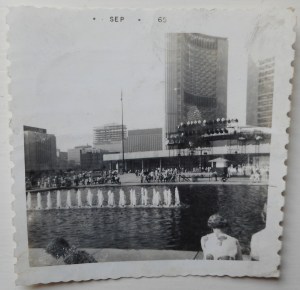
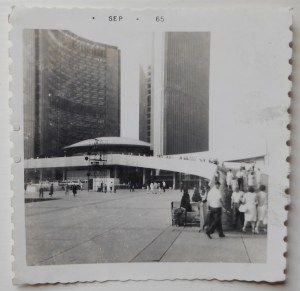
 

My father came to Canada from the Azores, an archipelago of nine small islands in the North Atlantic, when I was just six years old. It wasn’t until three years later that I saw him again when my mother and I joined him in Toronto. During the years of his absence, my father wrote every week.

Along with his letters, he sent black and white photographs of Toronto landmarks: Lake Ontario; Exhibition Place; University Avenue; the Toronto Dominion Towers. My father documented everything he saw through the lens of his small Kodak pocket camera, and wrote meticulous handwritten explanations on the back of each photograph so that I would become familiar with the city.

The photograph that filled me with awe was one that showed what looked like a flying saucer with two towers on either side. My father wrote that this was the recently completed Toronto City Hall. It was considered an innovative structure at the time and had won international acclaim.

It is amusing to note that what impressed my father most about this amazing building, were the three levels of underground parking! But then my father loved cars. So the subterranean car park proved to be more interesting to him than the actual award-winning building.

Still, I felt scared and worried for my father’s safety. I truly believed that he was going to be abducted by space monsters who would take him away on their flying saucer, and I prayed every night that he might return home unharmed from this futurist alien city.

When I finally arrived in Toronto, my father showed me the places I recognized from his photographs. The two dimensional black and white images were now fully real as I gazed in wonder at the tall buildings in front of me. And the flying saucer was really there for all citizens to climb on board and fly away; concrete magic that still scared me as I held my father’s hand the day he took me on a tour of City Hall.

As I look back across the decades, I am grateful that my father had found a way to remain connected to me. Through these photographs, he brought the city of Toronto in 1965, to my small insular island world. In doing so, my father was showing me the rich, new life he was preparing for me in my new home, Toronto.

Originally entered in the CBC contest, Your Bloodlines: Stories from the Public, 2013

March 6, 1834, Toronto is incorporated as a city. Today is Toronto’s 182nd Birthday!


Posted in Uncategorized | 2 Comments

Exile


        Nordeste coast, island of S. Miguel, Azores


“My relationship with Italian takes place in exile, in a state of separation.” So starts Jhumpa Lahiri in her achingly profound and beautiful essay on identity, language and belonging, “Teach Yourself Italian.”

By the time she referenced the Portuguese writer and poet, Fernando Pessoa, I was convinced that my own journey into finding home through language, mattered. It’s not the specific language that is of significance; rather, the reality that for some of us, living through language and geography, makes us whole. I wish I had Jhumpa’s ability and eloquence to articulate my own feelings on this issue of Language and Belonging. I try, but it always feels like there’s something crucial missing in my attempts to convey the same experiences she wrote about. But she got it.

She expressed the emotional journey I’ve travelled since visiting Ponta Delgada sixteen years ago where I experienced a visceral reaction to my birthplace and found myself doubting my own identity and its connection to my mother tongue.

My experience of cultural and linguistic fracture has been profound; and my recent attempts to somehow return myself to myself, has been a heart wrenching, solitary journey. But I still feel like some incomplete being, scattered and tossed about by the cold Atlantic waves, only to realize that a lifesaving raft waits for me near the shores of Lake Ontario, a place far more “at home” for me than the ocean waters I stubbornly long to swim in.

I would love to spend a month or more in the Azores, working out my inadequate language skills, but like a child, learning and taking it all in until the words become a part of me and the old language flowed effortlessly with each sound. The only shortcoming to this immersion plunge is the knowledge that English will, inevitably, be pushed aside, sent away from my brain, for Language is like a jealous lover and does not want to share its sounds and conjugations, verbs and syntax with another. This is why I will never be able to flow easily from Portuguese into English and back. There is only room for one lover at a time.

Posted in Uncategorized | 3 Comments

The Emigrantes

The EmigrantesThe Emigrante Boy

I came upon the Monumento ao Emigrante in Ponta Delgada, across Avenida Infante Dom Henrique, close to Forte S. Brás and Campo de São Francisco: a bronze family in a permanent act of immigrating. The father, with one arm lifted high, points towards the future, his other hand holds fast to his wife’s hand as she stands behind him, holding the hand of their little son. Neither parent acknowledges the child’s intense plea to stay.

This homage to Azorean immigrants left me stunned when I first saw it in the year 2000. The statues were a visual symbol of me and my parents and all the thousands of families who left the islands for other worlds. It captured the grief and tearing apart I had felt decades earlier when, one rainy dark morning, I walked down the street with my parents, against my will, to a foreign country.

I had traveled to the Azores with my Anglo-Canadian partner, excited to show him the place of my birth and early childhood. For over six years he had heard my stories of immigration. The statue revealed for him our lives as emigrantes in ways I could not have anticipated. He wept with heartfelt sorrow as he finally understood the meaning of saudade.

It also frightened him to witness my visceral reaction to the island of my birth. The encounter provoked shock waves of emotion through me right from the moment I spotted the presépio landscape from my airplane window. The smells, the sounds, the humidity and the scent of ocean clinging to walls, awoke all my dormant longing and desire for my childhood home after such a long absence.

He saw me raptured into a world of mythical magnitude as my Canadian “self” slipped away. I could not even bear his presence pulling me back to exile. It upset me to speak English as I no longer wanted to be in translation. I wanted to immerse myself in the Portuguese language. This was the key to entering and losing myself again in my boyhood world. The trip almost ended our relationship, so violent were my emotions of reconnecting with home.

We survived the trauma that our vacation triggered in us, and we are still together, partly because the statues allowed my partner to feel a lasting kindness for my fractured, ambivalent soul: half Canadian; half Azorean; and in many ways still the confused little boy who wondered for so long why he had to leave his island home.

I have returned to the Azores several times since then and each new visit feels like a homecoming. There is less saudade and more healing with each visit, and the pain of my immigration is fading away. Now I stand again in front of the “Emigrantes” wishing that the bronze family might move beyond that captured moment of leaving. I wish I could embrace the boy and tell him that it will be alright.

I hope that we, who have experienced the Azorean diaspora, can be freed, too, knowing that we can belong to our islands again, even though home has become elsewhere.

Originally in Mundo Açoriano, July 24, 2014 and in Twas, Fall-Winter 2014.

 Today is the 48th anniversary of my arrival in Toronto on February 4, 1968


Posted in Uncategorized | 1 Comment